The own goal of negative messaging
It’s the football World Cup. Millions enjoy the spectacle, fans get excited, advertisers like Airbnb celebrate ‘the good things that happen when the world meets’… and the sustainability community falls into a classic trap.
That’s because the messaging on the feeds of sustainability professionals is relentlessly negative:
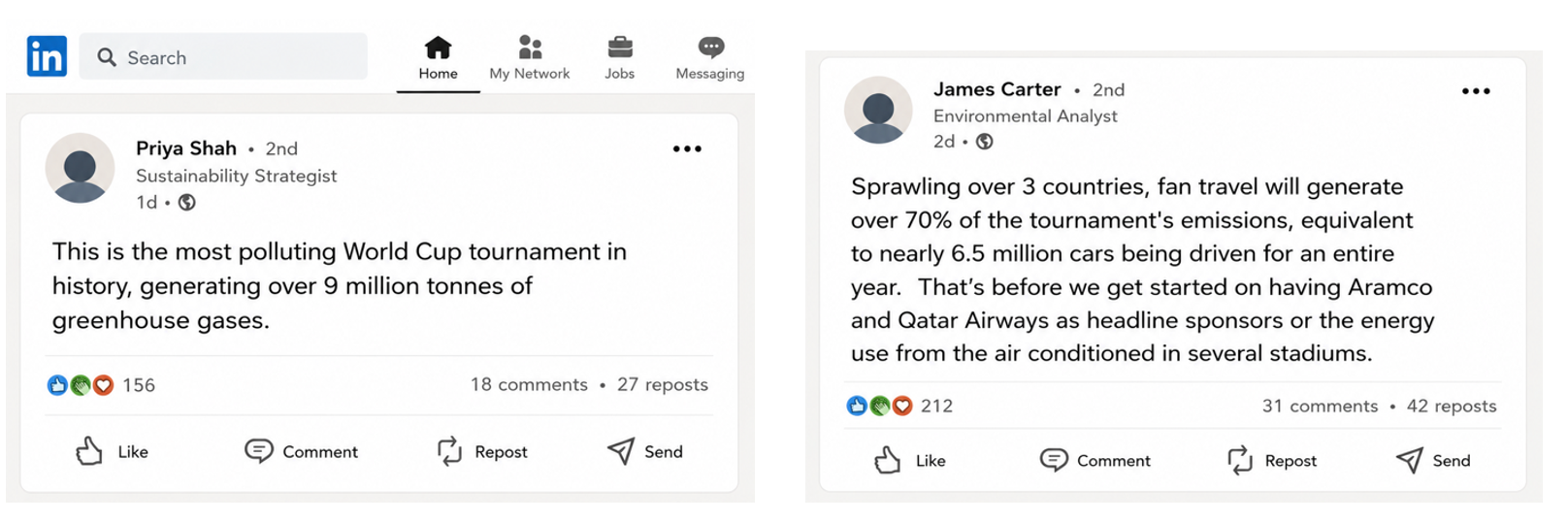
All valid comments, but ones that ostracise sustainability professionals as boring killjoys.
This is one of problems Northbrook PR was created to address. We believe our best hope for landing sustainability messages is to be one of the fans. To offer content and experiences that bring joy rather than despair.
Negative environmental messages tend to induce ‘eco-paralysis’. i.e. individuals feel so overwhelmed by the scale of the threat, they unconsciously detach to protect their emotional security.
So here’s three examples of where we think sustainability messages have been delivered as perfectly as a Messi through ball
THE SECRET TESLA MASTER PLAN
Back in 2006 when Tesla was just getting started its CEO wrote a famous note declaring that the focus of the company and its marketing was to build amazing cars. The focus was not on the fact that those cars were green electric vehicles. As the note says: “Critical to making that happen is an electric car without compromises, which is why Tesla… is designed to beat a gasoline sports car like a Porsche or Ferrari in a head-to-head showdown. Then, over and above that fact, it has twice the energy efficiency of a Prius”.
So part of the journey for Tesla, from start-up to the world’s most valuable car company, was to ‘avoid the green crap’ and focus on the performance. A car that was fast, technologically advanced, and aspirational
(Side note: Podcast recommendation, there’s some interesting insights in The Rest is Politics US podcaston how a snub by President Biden in 2021 marked the point where Musk and the green movement parted ways).
DON’T LOOK UP
A film about eco-paralysis is itself a great example of a sustainability message delivered in a positive package, that avoids eco-paralysis.
The first to say aboutDon’t Look Upis that it’s a great movie with enormous viewing figures. It soon became the second most successful movie of all time on Netflix according to Deadline, watched by close to half a billion people according to filmmaker Adam McKay.
What’s notable is that it’s also inspired others to act. Nationwide climate protests were branded ‘Look Up Day’, the film's producers partnered non-profit Count Us In on a climate action platform andone studysuggested that watching the film decreased the likelihood of a watcher voting for someone who opposes significant climate action.
MR BATES V THE POST OFFICE
Away from climate, the ITV drama Mr Bates Versus the Post Office in 2024 was an entertaining example of how an TV drama can hit home in a way that reams of negative press coverage cannot.
The programme dramatizes a miscarriage of justice in the UK where around 900 managers of local post offices were wrongfully prosecuted for theft and false accounting based on faulty data from a computerized accounting system.
The scandal had been exposed years previously by magazines such as Computer Weekly and Private Eye, but it was not until the ITV drama sparked unprecedented public outrage that emergency legislation was passed to quash hundreds of wrongful convictions and accelerate compensation payments to victims.
What changed? The scandal was a complex and dry topic (imagine a chat about Scope 3 emissions methodology), and it wasn’t until the production team managed to bring the impact of the scandal to life that the UK connected emotionally with the issue, catalysing action.
---
Author: Elliot
